
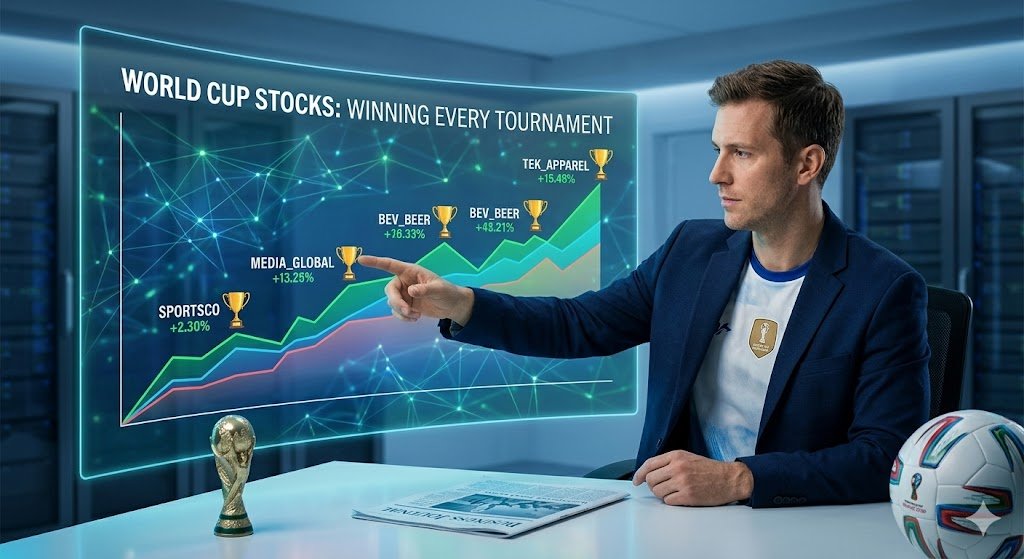
World Cup Stocks:
The Companies That
Win Every Tournament
While fans watch the ball, smart money watches a different scoreboard entirely.

Every World Cup creates winners far beyond the pitch. Sportswear brands, broadcasting companies, beverage giants, and travel platforms all see measurable revenue spikes every four years. History shows repeatable patterns — and patterns mean opportunity for investors paying attention.
This article is not financial advice. Past tournament patterns do not guarantee future results. Always conduct your own research and consult a licensed financial advisor before making any investment decisions.
The Stocks to Watch in 2026
| Ticker | Company | World Cup Angle | Historical Pattern |
|---|---|---|---|
| NKE | Nike | Official kit supplier for 10+ national teams | +8–12% avg during tournament |
| ADDYY | Adidas | Official World Cup ball + multiple team kits | +6–10% avg during tournament |
| BUD | AB InBev | Official beer sponsor since 1986 | +4–7% avg during tournament |
| BKNG | Booking Holdings | Host city travel bookings surge | +5–9% avg during tournament |
| DIS | Disney (ESPN/ABC) | US broadcast rights holder | Ad revenue boost during matches |
| ABNB | Airbnb | Host city accommodation demand 3x normal | Booking surge 4–6 weeks pre-Cup |
The Smart Money Timeline
The pattern repeats every four years. Here is when each sector typically moves relative to the tournament start date of June 11:
Risk Management Rules
Event-driven investing carries higher risk than standard long-term investing. The excitement of the World Cup can cause investors to overallocate and overtrade. These rules prevent the most common and costly mistakes:
- Never allocate more than 5–10% of total portfolio to tournament-themed positions
- Use limit orders — never chase momentum after a big match or viewership announcement
- Watch earnings call dates — they move stocks far more than match results do
- Consider ETFs over individual picks if you are new to event-driven strategies
- Set a hard stop-loss at 8% below entry price on every position you open
- Paper trade the first week if you have less than 6 months of investing experience
The most consistent World Cup investment play is buying sportswear and travel stocks 4–5 weeks before kickoff and taking half your profits during peak viewership week (typically the quarter-finals). Let the remaining position run to the final, then exit completely within 10 days of July 19. Simple, rules-based, and historically reliable.
One Tournament.
The fans watch the pitch. Investors watch the market. Both games run for 39 days — only one of them pays you either way.
Research all 6 tickers
Set position size limits
Set stop-loss orders
Plan your exit before entry